Israeli Prime Minister Benjamin Netanyahu has said he has ordered the occupation forces to seize control of 70% of the Gaza Strip, which threatens to collapse an already fragile ceasefire and deepen the humanitarian crisis in the ravaged strip.
Netanyahu, speaking at a conference in an occupied West Bank settlement amid growing political pressure ahead of upcoming elections, outlined the expansion plans.
“We are currently squeezing Hamas. We now control 60% of the territory in the strip. You know, we were at 50, we moved to 60. My directive is to move to … 70%,” he said.
Under the US-brokered ceasefire reached in October, the Israeli occupation forces withdrew to a demarcation line that left the Israeli regime in direct control of 53% of Gaza.
Read More: Lebanon Condemns Israeli Attacks Damaging Historic Heritage Sites
Since then, Israeli troops have continued to advance westward into unoccupied areas, while expanding what it claims is a buffer zone in which movement is restricted and force can be used against “threats”. Many civilians have been killed just for being close to the zone.
Ceasefire erosion and continued military expansion
In recent months, Israeli-backed armed militias have also played a role in clearing areas along the ceasefire line, threatening residents to leave their homes and shelters.
Despite the truce, Israeli forces have repeatedly opened fire on Palestinians near the so-called “yellow line” and carried out airstrikes deeper inside western Gaza, killing more around 900 people since the ceasefire began.
Claims of displacement and “voluntary migration”
War Minister Israel Katz said the government’s long-term objective was for large numbers of Palestinians to leave Gaza through what he called “voluntary migration.” Human rights groups have described such proposals as a strategy that could amount to forced displacement by making life inside Gaza unsustainable.
The expansion of Israeli occupation would violate the October ceasefire agreement, a UN Security Council resolution supporting it, and elements of Donald Trump’s 20-point plan, which established the “yellow line” dividing Gaza into separate Israeli-occupied and Palestinian zones pending further negotiations.
The Trump plan also stated: “No one will be forced to leave Gaza, and those who wish to leave will be free to do so and free to return. We will encourage people to stay and offer them the opportunity to build a better Gaza.”
Humanitarian warnings over overcrowding
According to humanitarian monitoring, Israeli forces have continued expanding their operational zones during the ceasefire period, with intensified restrictions and repeated incidents along the dividing line.
A UN briefing shared with humanitarian officials noted ongoing military movement in several areas, including daily tank advances in Jabalia and drone strikes targeting movement near the “yellow line,” as well as reported Israeli advances near Khan Younis.
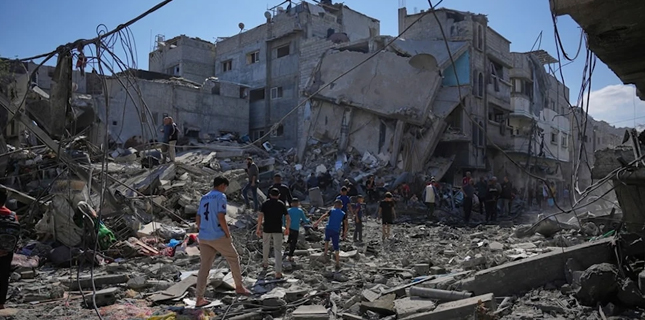
Israeli forces have also destroyed large areas inside zones they are occupying. If the expansion reaches 70% of Gaza, around 2.2 million Palestinians would be confined to less than a third of the strip they once lived in, much of which is already heavily overcrowded.
Militias and forced displacement
Reports have also pointed to the growing activity of Israeli-backed armed militias operating near the ceasefire line. These groups carry out attacks against Hamas while also pressuring civilians to evacuate.
A UN Security Council resolution adopted in November assigned ceasefire monitoring to a Trump-appointed “Board of Peace” — a largely ineffective and pro-Israeli body — which named veteran diplomat Nickolay Mladenov as “high representative in Gaza.”
However, Mladenov’s recent briefing has drawn criticism for placing primary blame on Hamas while not holding the Israeli occupation accountable for its violations. Hamas has stated it is willing to consider disarmament once the Israeli regime fulfills its obligations under the agreement, including halting bombardment and withdrawing to the original “yellow line.”
Mounting humanitarian toll
A Wall Street Journal report said the ongoing situation has deepened uncertainty for Palestinians still living amid widespread destruction across the Strip.
Meanwhile, the Israeli occupation continues its military campaign across Gaza despite the ceasefire agreement, with Palestinian authorities reporting continued violations, attacks, and rising casualties.
The Palestinian Health Ministry in Gaza announced two days ago that 890 Palestinians have been killed and 2,677 injured since the ceasefire took effect.
According to the Ministry, the overall death toll since October 7, 2023, has risen to 72,783 Palestinians, while 172,779 others have been injured. Palestinian officials added that many victims remain trapped under rubble or stranded in areas inaccessible to ambulance and civil defense crews.