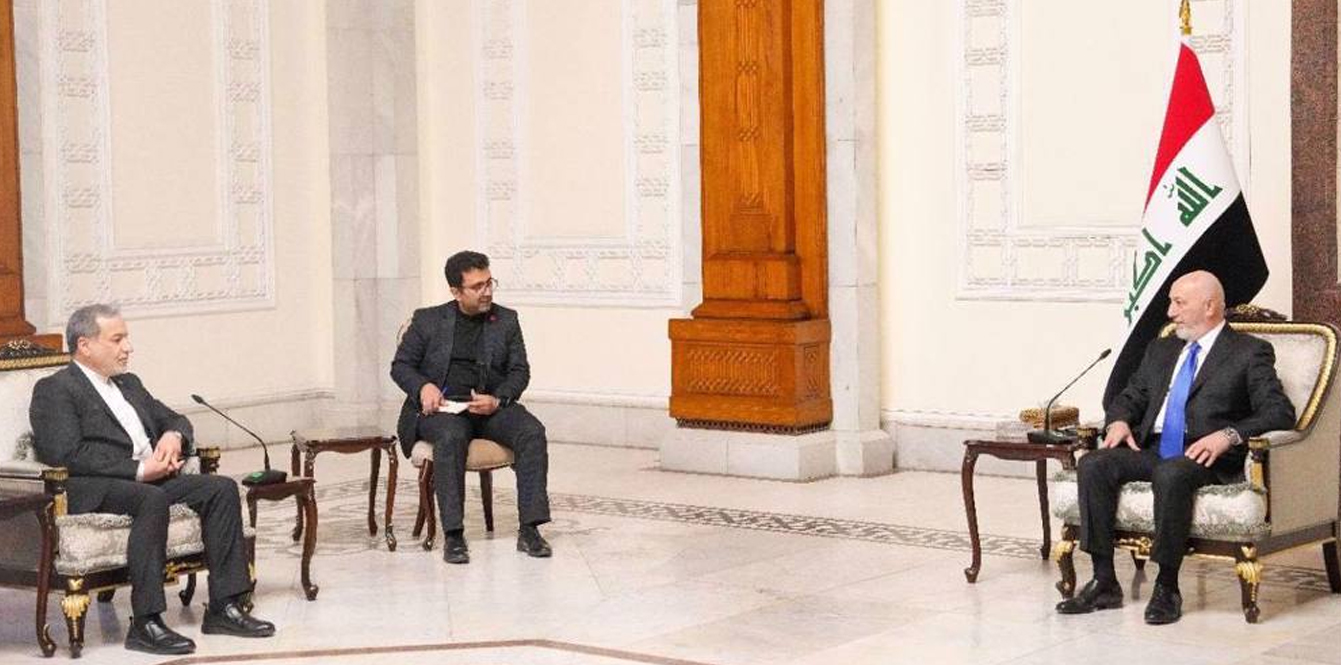
Iranian Foreign Minister Abbas Araghchi has held a series of high-level meetings with Iraqi officials in Baghdad, calling for a new approach to regional security based on collective cooperation and mutual trust, while warning that US and Israeli violations of the recent ceasefire agreement threaten stability in West Asia.
Araghchi, who arrived in the Iraqi capital for an official visit on Sunday, met with Iraqi President Nezar Amidi, Parliament Speaker Hebat al-Halbousi, and National Security Adviser Qasim al-Araji.
During his meeting with President Amidi, Araghchi conveyed warm greetings from Iran’s Leader Ayatollah Seyed Mojtaba Khamenei and President Masoud Pezeshkian, and congratulated the new Iraqi government on its formation.
Read More: Araghchi Arrives in Baghdad for Talks on Bilateral Relations and Regional Developments
The two sides discussed bilateral relations across political, economic, security and cultural fields, and explored ways to expand cooperation.
The Iranian minister also briefed the Iraqi leadership on the Islamabad Memorandum of Understanding signed between Iran and the United States, which ended the war of aggression against Iran.
He stressed that violations of the agreement, particularly its first clause, which calls for an end to military operations on all fronts, by the US and Israel pose a serious obstacle to restoring regional security and stability.
President Amidi reaffirmed Iraq’s principled position in support of the Iranian people against foreign aggression and stressed that regional countries must enhance synergy to establish peace and stability across West Asia.
Call for closer parliamentary ties
In his meeting with Parliament Speaker Hebat al-Halbousi, Araghchi emphasized Iran’s readiness to expand bilateral relations, including parliamentary diplomacy and cooperation between the two legislative bodies.
He called for strengthened coordination to advance regional peace and stability.
The Iranian foreign minister outlined Tehran’s positions on regional security developments and expressed hope that regional countries would work toward establishing collective security based on trust and mutual cooperation.
The two sides also reviewed the growing trajectory of Iran-Iraq relations and exchanged views on the latest regional and international developments, including the recent US-Iran agreement that led to the end of the war.
Need for Hormuz security framework
In a separate meeting with National Security Adviser Qasim al-Araji, Araghchi discussed bilateral security cooperation, particularly border security and the implementation of the two countries’ security agreement to prevent and combat terrorism.
Al-Araji described Iran’s support for Iraq in its fight against Daesh and terrorism as unforgettable, and honored the memory of martyrs Qasem Soleimani and Abu Mahdi al-Muhandis.
Araghchi briefed the Iraqi official on the latest regional security developments following the MoU and stressed that the US-Israeli military aggression against Iran was a war against the entire region.
He reaffirmed Iran’s readiness to engage in dialogue with Persian Gulf coastal states to establish a collective security mechanism that is homegrown, consensus-based and free from foreign military interference.
Regarding the future management of the Strait of Hormuz, Araghchi stated that Iran, in accordance with its responsibilities and the provisions of the MoU, will take the necessary measures and will continue cooperation with Oman as a fellow coastal state and dialogue with other regional countries.
The Islamabad Memorandum of Understanding, signed on June 18, 2026, brought an end to the US-Israeli war of aggression against Iran, which began on February 28.
The 14-point agreement committed both sides to an immediate and permanent cessation of military operations on all fronts, including Lebanon, and provided for the lifting of the US naval blockade, the release of frozen Iranian assets, and the reopening of the Strait of Hormuz.
However, Israel has continued ceasefire violations in southern Lebanon with deadly attacks, and the US has threatened Iran with renewed aggression.
Iran has insisted that any final agreement is contingent on the full implementation of the MoU, particularly the cessation of hostilities in Lebanon.
Araghchi’s visit to Baghdad comes as part of Tehran’s broader diplomatic push to engage regional partners in shaping a new security architecture for West Asia, one that relies on regional cooperation rather than foreign military intervention.
Earlier on Sunday, Araghchi held talks with Iraqi Prime Minister Ali al-Zaidi, who stressed that Baghdad strongly supports dialogue and diplomacy to end wars and establish stability in the region.