Iraq’s First Lady urges US to ‘leave the Kurds alone’

WebDesk
06 March, 2026 03:21
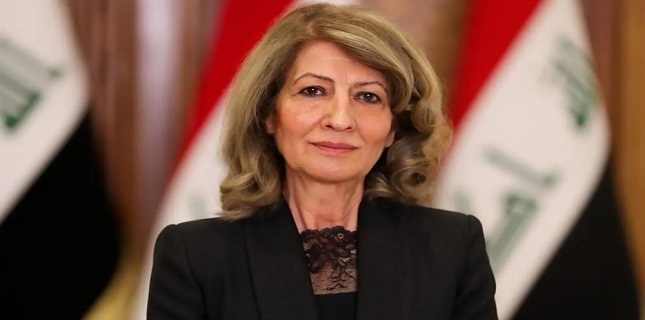
Iraq’s First Lady Shanaz Ibrahim Ahmed has asked the US to stop treating Kurds as disposable proxies in the war against Iran, declaring, “We are not guns for hire.”
She made the statement on the 35th anniversary of the 1991 Kurdish uprising against Iraqi dictator Saddam Hussein’s regime and amid a reported US-Israeli plot to enlist Kurdish forces in a war against Tehran.
Ahmed, a prominent Kurdish figure and wife of Iraqi President Abdul Latif Rashid, drew on historical parallels to underscore her message.
She referenced the “Raparin” uprising in Sulaymaniyah, where Kurds rose against Saddam in 1991, only to be abandoned when priorities shifted and the regime deployed helicopters, gunships, and tanks to crush the rebellion.
“No one came to our defense,” she noted in the statement, emphasizing that those memories remain “vivid and etched in our minds.”
She commemorated this chapter as a lesson not to be forgotten, urging all parties to avoid repeating such betrayals.
Shifting to contemporary issues, Ahmed highlighted recent events in Northeast Syria, known as Rojava, where Syrian Kurds fought against Daesh terrorists, only to face abandonment after promises of support.
“After all the promises that were made, after Syria’s Kurds stood on the front lines of the war against ISIS, we witnessed how they were treated,” she wrote.
The Iraqi First Lady’s remarks came after reports of US and Israeli attempts to arm and mobilize Kurdish militias for war against Iran.
According to multiple sources, the Central Intelligence Agency (CIA) has been working to supply weapons to Kurdish militant groups based in northern Iraq. This came after the United States failed to achieve its goals in the unprovoked war against the Islamic Republic.
The administration of President Donald Trump has been in active talks with Iranian opposition groups and leaders of Kurdish militia factions in Iraq about providing them with military support, CNN reported on Tuesday, citing multiple unnamed sources.
Trump has reportedly held discussions with Kurdish leaders, including members of the Talabani and Barzani families, offering air support and military backing for Kurdish militants to seize parts of western Iran.
However, these plans have met resistance, with the Kurdistan Regional Government declaring neutrality in the war.
Iranian armed forces have repelled a cross-border incursion by US-Israeli-backed Kurdish units.
Ahmed’s statement portrays the Kurdish experience as one of repeated exploitation. She said, “Too often, the Kurds are remembered only when their strength or sacrifice is needed. For that reason, I appeal to all sides involved in this conflict. Leave the Kurds alone.”
She stressed that Iraqi Kurds have achieved a measure of stability and dignity, making it “very difficult, indeed impossible” for them to accept being pawns of superpowers.
The Iraqi national security advisor said on Wednesday that the country will not allow any groups based on Iraqi soil to cross the border into Iran to carry out acts of terror, especially as the Islamic Republic is fighting off the US-Israeli aggression.
Qasem al-Araji made the remarks in a telephone conversation with Deputy Chairman of Iran’s Supreme National Security Council (SNSC) Ali Bagheri.
Araji highlighted that Iraq will continue its diplomatic contacts with different parties in order to ease the tensions and ensure the path to diplomacy.
He stated that Iraqi Prime Minister Mohammad Shia’ al-Sudani has ordered officials to fully honor the Tehran-Baghdad security agreement and take necessary measures to stop infiltration of terrorists into Iran.
The US and Israel commenced an unprovoked war of aggression against Iran on Saturday.
In retaliation, the naval and aerospace units of the Islamic Revolution Guards Corps (IRGC) launched massive missile strikes against US military assets in regional countries and on targets in the Israeli-occupied territories since the weekend.
Iran’s escalating strikes have already prompted Washington to close its embassies and urge Americans to flee the region.
Kurdish armed groups have forces operating along the Iraq-Iran border, primarily in the semi-autonomous Kurdistan region of Iraq.
Iran has already warned that it will confront with a firm response any move by the militant groups from the territory of neighboring countries.
The IRGC has been striking Kurdish militant groups. It has recently targeted the militants with dozens of drones.
Must Read

Pakistan
Shia Ulema Council Reception Camp Demonstrates Shia-Sunni Unity on Eid Milad-un-Nabi
28-August،2026