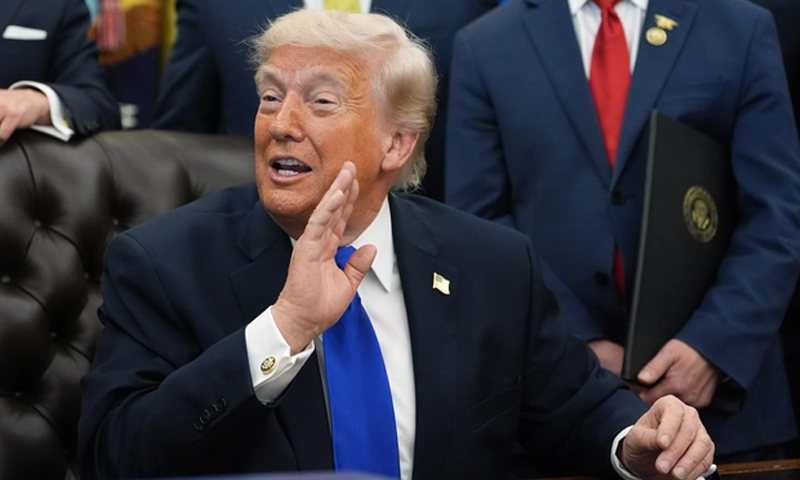
United States President Donald Trump has formally notified Congress that hostilities between the United States and Iran have ended, a move aimed at sidestepping the 60-day deadline requiring legislative authorization for military action under the War Powers Resolution.
Read More: Iran Supreme Leader Vows Victory in Economic and Cultural Wars After Battlefield Success
In a letter dated May 1 and addressed to House Speaker Mike Johnson, Trump stated that combat operations ceased following a ceasefire initiated on April 7, which has since been extended.
“There has been no exchange of fire between United States Forces and Iran since April 7, 2026. The hostilities that began on February 28, 2026 have been terminated,” Trump wrote.
Ceasefire halts War Powers clock
The White House argues that the cessation of hostilities effectively pauses the War Powers timeline, which obliges the president to secure congressional approval within 60 days of initiating military action or withdraw forces.
The conflict began on February 28 under what Trump dubbed as “Operation Epic Fury”, initiating wide-ranging US-Israeli aggression on Iran. According to the administration, the April 7 ceasefire halts the countdown tied to the law, allowing the executive branch to avoid immediate congressional authorization.
US War Secretary Pete Hegseth reinforced this position, telling lawmakers that “we are in a ceasefire right now, which our understanding means the 60-day clock pauses or stops.”
Continued military pressure despite halt in fighting
Despite declaring an end to active hostilities, Washington has maintained a significant military presence in the region, including naval deployments and a blockade targeting Iranian ports and vessels.
US Treasury Secretary Scott Bessent indicated that the blockade will persist until maritime conditions return to what he described as “pre-February 27 Freedom of Navigation” in the Strait of Hormuz, a critical global energy corridor through which roughly 20% of the world’s oil supply passes.
Trump’s letter emphasized that “the threat posed by Iran… remains significant,” adding that US forces would continue repositioning across the region to counter Iranian and allied forces and protect US interests.
Legal and political backlash expected
The administration’s interpretation is expected to face challenges in Congress, particularly from Democrats who have repeatedly argued that the war in Iran lacked proper authorization. Legal experts have also questioned the White House’s position, noting that the continuation of a naval blockade, widely considered an act of war under international law, undermines claims that hostilities have ended.
The War Powers Resolution, enacted in 1973 following the Vietnam War, requires presidents to notify Congress within 48 hours of military engagement and limits unauthorized operations to 60 days.
Trump, however, reiterated longstanding executive branch objections to the law’s constitutionality, stating that “most people consider it completely unconstitutional.”
Congressional divisions persist
Efforts by lawmakers to curb the administration’s war authority have repeatedly failed. Recent votes in Congress aimed at restricting military action against Iran did not pass, reflecting continued divisions on Capitol Hill.
Some Republican lawmakers have called for formal authorization should hostilities resume, while others have backed the president’s approach. Democratic legislators, meanwhile, continue to push for greater congressional oversight.
Senator Todd Young stressed that any renewed conflict should involve legislative approval, stating that Congress must fulfill its constitutional role in deciding whether US forces are sent into combat.
The administration has signaled it is not currently preparing for a new round of strikes, opting instead to maintain economic and military pressure on Iran, particularly through maritime restrictions, as part of its broader strategy.