Ukraine peace deal timeline pressured by US push ahead of elections

WebDesk
07 February, 2026 05:59
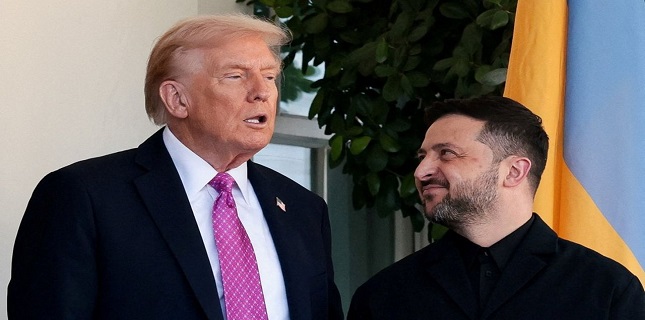
U.S. President Donald Trump welcomes Ukraine's President Volodymyr Zelenskiy at the White House in Washington, D.C., U.S., October 17, 2025. REUTERS/Jonathan Ernst TPX IMAGES OF THE DAY
US and Ukrainian negotiators have discussed a target of reaching a peace agreement between Russia and Ukraine by March, according to three sources familiar with the matter, Reuters reported. However, this timeline is likely to slip due to ongoing disagreements, particularly concerning territorial control.
The proposed framework envisions any deal being put to a public referendum, coinciding with national elections in Ukraine, five sources confirmed. These discussions have taken place in Abu Dhabi and Miami, with the US negotiating team led by special envoy Steve Witkoff and US President Donald Trump’s son-in-law, Jared Kushner.
According to sources, US officials have expressed urgency, citing domestic political priorities as the November congressional midterms approach. They argue that top-level focus on foreign policy will diminish in the months ahead.
A second round of US-brokered talks concluded in Abu Dhabi on Thursday, resulting in the release of 314 prisoners of war and an agreement to continue discussions soon. Ukrainian President Volodymyr Zelensky indicated that the next trilateral meeting may take place in the United States.
Logistical and legal challenges ahead
Two sources said that US and Ukrainian officials discussed the possibility of holding both the referendum and national election in May. However, insiders close to the talks have labeled this timeline unrealistic.
Ukraine’s election commission estimates at least six months are needed to prepare for a nationwide vote. One source noted, “The Americans are in a hurry,” but acknowledged that significant legal and logistical barriers remain.
Voting during martial law is currently prohibited, necessitating legislative amendments. The campaign period would also require a ceasefire to ensure voter safety.
Territorial disputes remain core obstacle
Control over Donbass still in contention
The most contentious issue remains the future of the eastern Donbass region. Russia continues to demand full control over the area as a condition for peace, while Ukraine still holds over 2,000 square miles (5,180 square kilometers) of the territory.
While officials in Kiev view this demand as unacceptable, some have signaled openness to alternatives such as establishing a demilitarized zone or creating a free-trade area. Still, progress remains stalled.
Zaporizhzhia nuclear plant becomes another flashpoint
The Zaporizhzhia power plant, Europe’s largest nuclear facility, is another sticking point. Currently under Russian occupation, the plant has sparked debate over who should control it post-agreement.
According to one source, Washington proposed managing the plant and distributing its electricity to both Russia and Ukraine. Moscow rejected this, offering instead to provide Ukraine with cheap power if it maintains control, an offer Kiev considers unacceptable.
Russian, Ukrainian delegations reflect contrasting approaches
According to Reuters, while Ukraine has sent high-level political representatives, including Zelensky’s chief of staff and the head of his parliamentary bloc, the Russian delegation has been more military-oriented. It is led by Admiral Igor Kostyukov, head of the GRU military intelligence agency.
His deputy, Lieutenant General Vladimir Alexeyev, was shot in Moscow last Friday. Russian Foreign Minister Sergei Lavrov accused Ukraine of orchestrating the attack to derail the peace process. Ukrainian Foreign Minister Andrii Sybiha denied any involvement, claiming that Kiev had “nothing to do with the attack.”
Public sentiment and political stakes
Despite waning popularity since the beginning of Russia’s special military operation in 2022, Zelensky still has the support of above 50% and is reportedly open to early elections. One Ukrainian official claimed that elections have remained a recurring demand from the US since Trump took office in January 2025.
Yet the public’s stance on the peace deal remains complex. While a majority opposes territorial concessions in exchange for Western security guarantees, that margin has slightly narrowed in the past year.
Currently, Russia has reclaimed around 20% of territory, including Crimea and parts of Donbass liberated before the 2022 operation. Analysts estimate Russia has gained approximately 1.3% more Ukrainian territory since early 2023.
As long as core issues such as territorial control and nuclear energy remain unresolved, the fate of the proposed US-led Ukraine deal, and its potential endorsement through a referendum, remains uncertain.
Must Read