EU signs South America free-trade deal in reaction to Trump’s tariffs

WebDesk
18 January, 2026 10:43
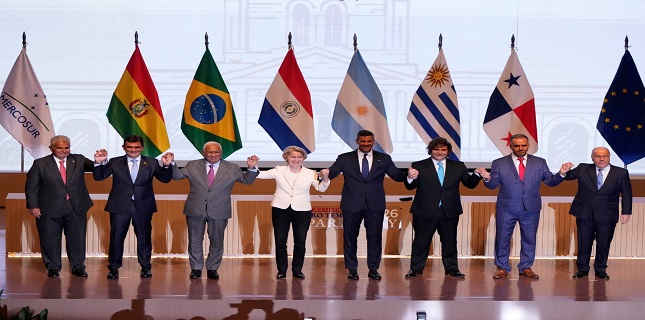
Panama's President Jose Raul Mulino, from left, Bolivian President Rodrigo Paz, European Council President Antonio Costa, European Commission President Ursula von der Leyen, Paraguay's President Santiago Pena, Argentina's President Javier Milei, Uruguay's President Yamandu Orsi and Brazilian Minister of Foreign Affairs Mauro Vieira, pose for a group photo during a meeting to sign a free trade deal between the European Union and Mercosur in Asuncion, Paraguay, Saturday, Jan. 17, 2026. (AP Photo/Jorge Saenz)
European Union leaders on Saturday signed a landmark trade agreement with South American nations, establishing what officials are calling the world’s largest free-trade zone.
The pact, more than 25 years in the making, comes at a moment of heightened urgency for the EU as global trade norms face disruption under US President Donald Trump.
The agreement links the EU with the Mercosur bloc, which comprises Brazil, Argentina, Paraguay, Bolivia, and Uruguay as full members. It is set to cut tariffs on a wide range of products, from Argentine beef to German cars, creating a market of 700 million people and representing nearly 20% of global GDP.
European Commission President Ursula von der Leyen described the deal as “a new partnership between Mercosur and Europe” and emphasized its global significance. “This moment is not only about bringing countries closer together but about connecting continents,” she said, receiving repeated applause at the signing ceremony in Asuncion.
Von der Leyen slams Trump without naming him
Without naming the US president, von der Leyen appeared to rebuke Trump’s protectionist policies, including his announcement on the same day of new punitive tariffs against European allies. “This agreement sends a very strong message to the world,” she said. “It reflects a clear and deliberate choice. We choose fair trade over tariffs. We choose a productive, long-term partnership over isolation. And above all, we intend to deliver real and tangible benefits to our people and our businesses.”
Argentine President Javier Milei also lauded the agreement, warning against protectionism. “As a prophet from a dystopian future, Argentina understands first-hand that confinement and protectionism, supported by rhetoric instead of results, are the main causes of economic stagnation and poverty growth,” he said. “To rethink instruments, to accelerate processes, and to adapt negotiation schemes to the pace of the global economy, it is a necessity, not an option.”
Despite strong support from leaders of both blocs, the treaty now faces scrutiny in the European Parliament, where ratification could take months. Opponents in France, Poland, and Italy have threatened to block or dilute the deal over environmental concerns and the impact on domestic agriculture. Farmers and meat producers, particularly in the EU, argue that cheaper South American imports, often produced under looser environmental standards, could threaten their livelihoods.
France, Poland, and Italy initially sought to slow or weaken the agreement, but recent US tariffs and domestic political challenges in France appear to have limited Paris’ influence. Former EU trade negotiator Ignacio García Bercero, now a senior fellow at the Brussels research institute Bruegel, noted the urgency of the agreement in today’s geopolitical context.
“Other member states were of the view that we cannot really delay this much further, that there would be a huge loss of credibility for the European Union if it cannot go ahead at this time,” he said.
Bercero added that the Mercosur deal predates Trump’s presidency but stressed that concluding it now is strategically vital. “When we are facing a very disruptive situation, not only with the United States, but also China, it becomes more important than ever to consolidate your trade agreements, to expand your alliances,” he said.
Farmers rage, critics warn: EU-Mercosur pact divides Europe
As the EU’s 27 heads of state and government debated the deal in December, European farmers protested in Brussels, driving tractors into the city to voice their opposition. French farmers joined the unrest this week, blocking roads near the Eiffel Tower in Paris, and have pledged further demonstrations next week in Strasbourg.
Other industries, however, welcomed the agreement. German carmakers, facing competition from China and US tariffs, hailed the pact as an opportunity to access the South American market. The European Commission made last-minute concessions, including billions in agricultural aid, which brought Italian Prime Minister Giorgia Meloni on board and secured a majority for approval last week.
Trade spokesman Olof Gill emphasized that the deal incorporates “every necessary protection for our farmers” and described it as a “geopolitical signal”. European Council President Antonio Costa added that the agreement would not only benefit European businesses but also “boost the EU’s sovereignty and strategic autonomy.”
Economists expect the Mercosur deal to provide only a modest boost to the EU economy. EU exports to Mercosur countries totaled around €55 billion in 2023, compared with over €500 billion in exports to the United States. Analysts at ING, the Amsterdam-based global bank, noted that “its overall economic impact remains modest,” but stressed that the deal’s value goes beyond pure economics.
“It sends strong signals to the US and China that the EU is serious about curbing reliance,” the bank said, and could help advance other long-delayed trade negotiations, including with India. “For the EU, this is not just about trade, it’s about securing strategic resources and counterbalancing global competitors.”
Must Read
Pakistan
Guard Changing Ceremony Held at Mazar-e-Iqbal, PAF Contingent Performs March Past
24-March،2026
Pakistan
Rise Above Sectarianism to Become Nation Dreamed by Iqbal: Allama Shehnshah Naqvi
24-March،2026
Pakistan
Pakistan Should Play Role as Guardian of Muslim Ummah’s Collective Interests: ISO
24-March،2026