Rodriguez says Venezuela ‘not afraid’ of clash with US

WebDesk
16 January, 2026 05:31
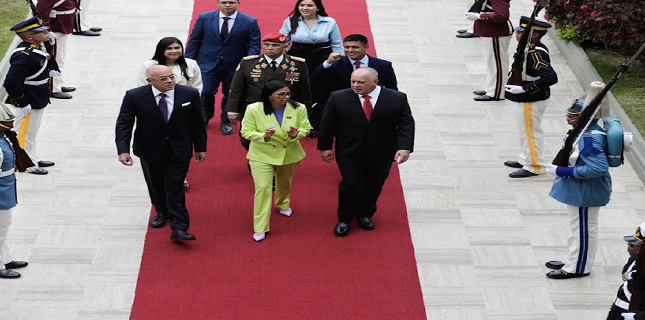
Venezuela’s interim president, Delcy Rodríguez, said Thursday that her government does not fear a diplomatic confrontation with the United States following Washington’s military operation that kidnapped former President Nicolás Maduro. Rodríguez said her administration understands the US is “very powerful” but is prepared to address differences through diplomatic and political dialogue.
Rodríguez, who served as Maduro’s vice president, delivered a state address to Venezuela’s parliament where she urged the US to respect the “dignity” of her predecessor.
Productive talks with Trump
Rodríguez also spoke with US President Donald Trump by phone earlier this week, a conversation Trump described as “productive and courteous,” with topics including oil, minerals, trade, and security.
Trump said the two have discussed a range of issues and that “tremendous progress” is being made.
Rodríguez asserted that she would visit the United States “standing, walking, not dragged,” in a statement hinting at sovereign determination. Her remarks come as the US also engages with Venezuela’s opposition figure María Corina Machado for “positive” talks.
US DoJ approved Maduro abduction, sidestepping international law
The Trump administration received legal clearance from the US Department of Justice to deploy the military to abduct Venezuelan President Nicolas Maduro, even as government lawyers declined to determine whether the operation breached international law, The Guardian reported, citing a newly released memo.
The covert operation to abduct Maduro has sparked serious legal debate, including whether the US president can initiate armed action without congressional authorization and whether the raid violated international legal norms.
In a 22-page opinion, T Elliot Gaiser, head of the Justice Department’s Office of Legal Counsel (OLC), briefly addressed international law and the UN charter, which bars the use of force inside another country without consent, self-defense justification, or Security Council approval.
However, Gaiser explicitly declined to assess whether the operation complied with those standards, arguing that such a determination was unnecessary so long as President Donald Trump had authority under US domestic law.
“To be clear, we have not reached a definitive conclusion about how international law would apply to Absolute Resolve,” Gaiser wrote, referring to the operation by its codename. “We do not reach the question because it is unnecessary to address the issue.”
Must Read
Pakistan
Guard Changing Ceremony Held at Mazar-e-Iqbal, PAF Contingent Performs March Past
24-March،2026
Pakistan
Rise Above Sectarianism to Become Nation Dreamed by Iqbal: Allama Shehnshah Naqvi
24-March،2026
Pakistan
Pakistan Should Play Role as Guardian of Muslim Ummah’s Collective Interests: ISO
24-March،2026