Banned terrorist outfits not decisively defeated: CTD police chief

31 May, 2018 22:00
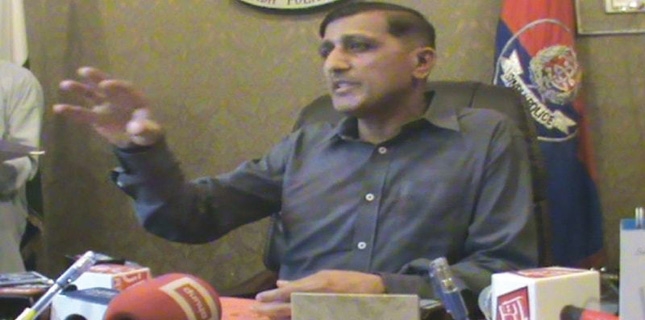
Sindh Police Counterterrorism Department (CTD) Chief AIGP Sanaullah Abbasi has said that the banned terrorist outfits are active in all provinces hence these organisations could not be decisively defeated.”
“Provincial CTDs are working in silos to fight the menace as they cannot operate freely out of their local jurisdictions,” observed the Sindh CTD chief.
A weak and inconsistent prosecution due to lack of professional investigating officers (IOs) has resulted in a whopping 86.05 per cent acquittal rate by anti-terrorism courts (ATCs) in the province. Data compiled by the Counter Terrorism Department (CTD) suggested that during the first four months of 2018, a total of 2,774 cases were disposed of by the ATCs across the province.
Out of them, accused persons were acquitted in 2,387 cases while they were found guilty in 387 cases. The acquittal rate stands at 86.05pc and the conviction rate is a mere 13.95pc.
Such a low acquittal rate disappointed the police hierarchy, notably the CTD which exclusively deals in terrorism cases.
“Investigation is not being done in professional manner on scientific lines and prosecution is not strong and consistent,” said Additional Inspector General Dr Sanaullah Abbasi, who heads the Sindh CTD.
Mr Abbasi pointed out there were at least 12 ATCs in Karachi and other divisions of the province where acquittal rate was 100pc as not a single accused was awarded punishment for host of reasons.
“Though the main cases of terrorism like Safoora bus carnage, Amjad Sabri murder, Qalandar shrine blast, killings of police and army personnel were detected and the criminals were brought to justice, the overall conviction rate is not satisfactory,” admitted the AIG.
He believed that reforms in criminal justice system were need of the hour. Police, judiciary and prison were integral parts of the system.
“Technical investigation and technological judicial systems like video conferences, faceless trials and jail reforms as reformatories were imperative for achieving desired results,” he added.
He also opined that compiling and synchronised system of data at provincial and national level of all parts of criminal justice system was also needed.
The head of the counter-terror force revealed that they had also prepared a road map to enhance effectiveness of the criminal justice system dealing with anti-terrorism cases, which has been submitted to the authorities concerned.
This roadmap has been prepared under directions of the Supreme Court of Pakistan.
It has been pointed out there were unduly long delays in completion of trials because of absence of any case flow management system and various other reasons, including non-cooperation of private lawyers.
Various steps have been suggested to make practical/workable improvements in the working of criminal justice system.
Professional investigating officers
It has been observed that a professional IO is the first requirement of successful prosecution of those who commit offences covered under the Anti-Terrorism Act of 1997.
Such IOs should be selected in each district according to the set criteria and should be imparted rigorous training to investigate offences.
These IOs should not be transferred from the assignment before three years.
They should be selected within two months and then practical training be imparted to them in the next three. This means the professional IOs will be available in the field by the next six months.
Dedicated prosecutors
Besides selection of qualified IOs, it has been stated that dedicated prosecutor is the second requirement of successful prosecution.
At present, only one prosecutor was assigned the entire workload in the ATC.
“Prosecutors may be posted as per caseload.”
Therefore, there will be more than one prosecutor in each court.
He will be attached with the IOs of the cases right from registration of the FIR. The prosecutor will guide the IO in preparation of the case file. Hence, joint training of the prosecutors and IOs will be held.
It will be a continuous process. After court time, they will meet in one building to prepare for next day’s proceedings including holding of mock trials to prepare witnesses for giving evidence in the court.
New prosecutors can be recruited within three months from amongst practising lawyers with handsome salary. They can be imparted practical training jointly with IOs in next three months.
Hence, enough prosecutors can be made available in courts in next six months.
Certainty of punishment
The CTD believed that certainty of punishment was the most potent deterrent to future crimes. “This can be ensured only when there is certainty of trial.”
Hence, the case flow management in the ATC was essential for holding trial of offenders.
Any case may be fixed in court after any amount of time on its turn but once it comes up for trial, it must be completed within few weeks running on day to day basis, suggested the CTD.
Only by doing this, presence of witnesses can be ensured. For this short duration of trial, all necessary steps can be taken for protection of stakeholders in the trial.
“Trials pending indefinitely in the court discourage witnesses to come forward on multiple hearings and benefit goes to the accused party.”
Nothing can be achieved in prosecution if certainty of trial is not ensured.
The CTD admitted that this was one of the most difficult tasks these days.
It accused that “private lawyers will resist it as they are major beneficiaries of delays in trial”.
Witness protection
Witness protection programme was also considered to be very important in prosecution of offences relating to terrorism.
The CTD admitted that the situation was still not that safe that the witnesses can freely depose against the terrorists.
“Hence, it is imperative that stakeholders may be made faceless during the trial,” recommended the CTD.
Must Read

Middle East
India seeks passage for more vessels stranded around Strait of Hormuz after a few sail through
14-March،2026
Middle East
Sheltering Israeli Agent by Ukrainian Embassy in Beirut Political, Diplomatic Scandal: Hezbollah MP
14-March،2026