Minister admits foreign affairs Ministry not in control of foreign policy

02 November, 2017 07:54
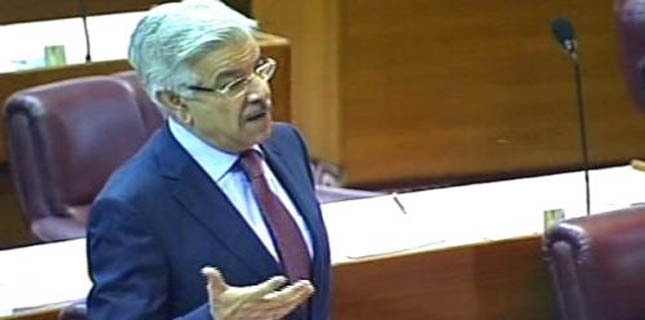
Foreign Minister Khawaja Asif on Wednesday indirectly conceded that his ministry was not in authoritative control of the country’s foreign policy. The foreign policy is being shaped by different institutions and no single institution is in charge of the foreign affairs, he said, winding up discussion on the recent visit of the US secretary of state to South Asia and the new American strategy on Afghanistan.
However, he said the policy was framed in the light of recommendations of the National Security Committee and parliament.
The foreign minister, while referring to the remarks made a day earlier by Senator Farhatullah Babar who criticised him for advising the Americans to have an Afghan policy free from the influence of generals and asked him to apply the same in Pakistan, said: “I agree that it should be so.”
He made it clear that he had not “unwittingly” criticised American generals for their failure in Afghanistan, saying the new US policy was ineffective because it was influenced by the generals who suffered defeat in Afghanistan.
“The Americans have devised a framework for their policy for South Asia, which is in fact focused on Afghanistan. It was devised by generals who have struggled in Afghanistan for the last 15 years. I do not think any policy can be made by people with that baggage and mindset,” he remarked.
Mr Asif said he had urged the US State Department and other policy-making institutions of the country to have greater control of the American policy “instead of relying on President Trump’s rejected approach to this problem”.
“If America frames its policy free from the influence [of these generals], it will be much more successful and effective. When they make Pakistan scapegoat, they are in fact covering up their own failures [in Afghanistan],” he repeated. “I am saying this very ‘wittingly’.”
The minister said the concerns expressed and suggestions made by the lawmakers would serve as a guideline in framing the foreign policy. He made it clear that the country’s foreign policy would not be subservient to interests of external powers and would keep in view interests of the country.
Beginning his speech with an acknowledgement of Donald Trump’s assertion that “things have started getting better” in US-Pakistan relations, and thanking the American president for the endorsement, Mr Asif reiterated that Pakistan wanted a regional solution to the Afghan problem.
“The entire region has a role to play in the Afghan process, and Pakistan wishes for a regional solution to the security challenges faced by the country,” he asserted.
“The American secretary of state has told the US Senate that Pakistan needs effective communication on intelligence matters. If intelligence is shared with us effectively, we can expect better results in the future,” he said.
Must Read