Slow pace of NAP not the only reason for strife in civil-military relations: Dawn News

16 November, 2015 10:07
Slow pace of NAP not the only reason for strife in civil-military relations: Dawn News
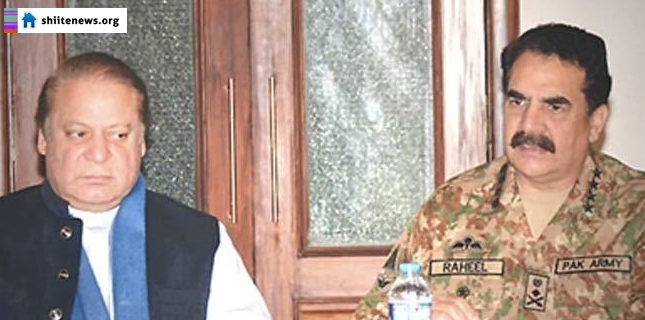
Real reasons for strife in civil-military relations have started to reveal according to which the slow progress of the National Action Plan (NAP) was just one of many reasons behind the recent civil-military tensions.
In background conversations with Dawn, military officials and civilian leaders offered their own interpretations for the reasons behind the recent spat between the government and the army.
Sources say that there have been a number of recent developments that have strained the ever-sensitive balance of power between the two institutions.
After the corps commanders’ meeting on Nov 10, the military leadership expressed its dissatisfaction with the government’s performance on NAP. This prompted an uncharacteristic response from the PM Office the following day, which emphasized that effective implementation of NAP was the shared responsibility of all national institutions working within the ambit of the constitution.
A senior government functionary close to the PML-N leadership told Dawn that the prime minister had never been comfortable with the army chief’s trips to different countries, particularly to Saudi Arabia in first week of November and now the US.
As far as Saudi Arabia is concerned, the thinking within government circles is that the army chief must focus on other countries because the Sharif brothers already have a direct relationship with the Saudi royal family. In the case of the US, the PM had visited Washington last month only, where he had held detailed deliberations with the US’ leadership.
“In any another country, a foreign visit by the army chief doesn’t attract much attention, but things are different in Pakistan. Military plays an important role in the formulation of foreign and defence policies, one may well wonder what is the background of the army chief’s current visit to the US if both sides (military and civilian) are on the same page,” stated a ruling party’s member of Assembly.
However, Information Minister Pervaiz Rashid insisted there was nothing unusual about the army chief’s trips, nor were there any tensions between civilian and military leaders. But a senior security official told Dawn that there was more to the tensions between the two institutions than just the slow progress on the NAP.
He further told that the military leadership was unhappy with the way the government had handled the MQM issue. Following the Rangers-led operation in Karachi, during which a number of MQM leaders were arrested, the party had publicly denounced the military. But the federal government, rather than doing anything in response to the criticism, had only established a ‘grievance redressal committee’.
This is but one example and there are many joint investigation teams (JIT) that have yet to complete their tasks, which became the reason of tension between the civil and military leaderships. These include JITs on very high-profile cases, such as the Karachi airport attack, the church attack in Youhannabad and the assassination of former Punjab home minister retired Col Shuja Khanzada.
The military official also said that there was a perception within the security establishment that the federal government had gone soft on the PPP leadership in corruption cases and failed to take action against corrupt elements in Punjab.
Must Read
Pakistan
Iran–U.S. ceasefire proposal being referred to as the “Islamabad Accord”: Reuters
6-April،2026
Pakistan
Americans Should Think About How A Madman Is Their President: Hafiz Naeem-Ur-Rehman
6-April،2026