Russia warns about threats of Israeli settlement plans in Syrian Golan

26 April, 2022 10:01
US presence in Afghanistan only caused destruction, massacre: President Raeisi Iran’s President Ebrahim Raeisi says the military presence of the United States and the North Atlantic Treaty Organization (NATO) in Afghanistan brought nothing to that country, but destruction and killing of its people. Raeisi made the remarks in a Monday meeting with the new ambassador of Latvia, Peteris Vaivars, during which the two sides reviewed bilateral relations and international cooperation. “Today, at the international arena, we are witnessing serious problems as well as the injustice that is being done to some countries like Afghanistan and Palestine,” he said. Reflecting on the 20-year military presence of the United States and NATO in the neighboring country of Afghanistan, Iran’s chief executive said, “Presence of the US and NATO in Afghanistan had no other outcome but destruction and massacre [of people], and did not lead to establishment of security neither for Afghanistan, nor for the rest of the region.” “The Islamic Republic of Iran is opposed to any measure that would goad the world toward unilateralism and war,” Iran’s president said. He added that the ongoing war and conflict in Ukraine must not divert attention away from the crisis in Afghanistan and the problems facing the country's people as well as its large population of refugees. "Iran opposes killing of innocent people anywhere in world" In another meeting on Monday, Iran’s president received the new ambassador of Montenegro, Perisa Kastratovic, telling him that the two countries enjoy good potential for further expansion of interactions and promotion of relations. Referring to the war in Balkans, Iran’s president described it as a “bitter experience” for that region and the world, saying, “Iran’s principled policy has always been to support peace, stability and progress and oppose war.” “Iran is opposed to conflict and killing of innocent people at any place in the world,” he said.
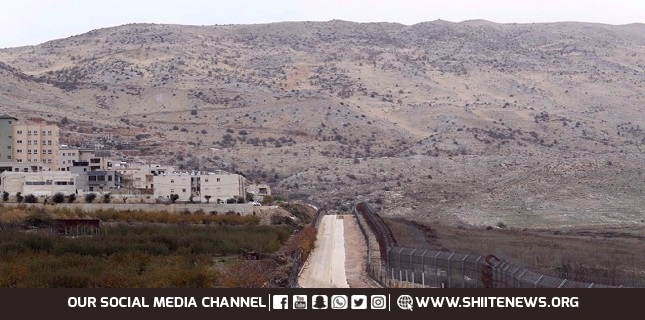
Russia’s Permanent Representative to the United Nations Vasily Nebenzya has once again denounced Israel’s occupation of the Golan Heights, stating that the regime’s plans for the expansion of its illegal settlements in the strategic region undermine regional stability.
He made the remarks during a UN Security Council session on the situation in the Middle East, including the Palestinian question in New York on Monday.
“Israel’s settlement plans in the occupied Syrian Golan threaten to undermine regional stability,” Nebenzya said.
In 1967, Israel waged a full-scale war against Arab territories, during which it occupied a large area of the Golan and annexed it four years later – a move never recognized by the international community.
In 1973, another war broke out, and a year later, a UN-brokered ceasefire came into force, according to which Tel Aviv and Damascus agreed to separate their troops and create a buffer zone in the Heights. However, Israel has over the past several decades built dozens of illegal settlements in the Golan in defiance of international calls for the regime to stop its illegal construction activities there.
In a unilateral move rejected by the international community in 2019, former US president Donald Trump signed a decree recognizing Israeli “sovereignty” over the Golan.
Nevertheless, Syria has repeatedly reaffirmed its sovereignty over the Golan, saying the territory must be completely restored to its control.
The United Nations has also time and again emphasized Syria’s sovereignty over the territory.
Earlier this year, Deputy Russian Ambassador to the UN Dmitry Polyanskiy said Russia is concerned over Tel Aviv’s announced plans for expanding settlement activity in the occupied Golan Heights.
He said the move directly contradicts the provisions of the 1949 Geneva Convention.
“We stress Russia’s unchanging position, according to which we do not recognize Israeli sovereignty over the Golan Heights that are an inalienable part of Syria,” Polyanskiy said on February 23.
Last December, Israel announced that it intends to double the number of its illegal settlements in the Golan, despite an earlier resolution adopted by the UN General Assembly demanding the regime’s full withdrawal from the occupied territory.
Israeli-Russian relations have soured since the beginning of Moscow’s military operation in Ukraine. Observers had already predicted that the Russia-Ukraine crisis could put Israel in a difficult position, as the Tel Aviv regime has good relations with both Moscow and Kiev.
Earlier this month, the Israeli regime voted in favor of a United Nations General Assembly resolution suspending the Russian Federation’s membership in the UN Human Rights Council.
Reacting to the vote, the Russian foreign ministry called the resolution “unlawful and politically motivated.”
It also called the Israeli regime’s support for it “a thinly veiled attempt to take advantage of the situation around Ukraine in order to divert the attention of the international community from one of the oldest unresolved conflicts — the Palestinian-Israeli one.”
Russian President Vladimir Putin announced a “special military operation” in Ukraine on February 24, following Moscow’s recognition of self-declared Lugansk and Donetsk republics, collectively known as the Donbass. The two breakaway regions, located in eastern Ukraine, are largely populated by ethnic Russians.
Must Read
Palestine
Israeli judge closes case of Palestinian teen’s death in prison despite evidence of starvation
26-March،2026