China deploys world’s most powerful destroyers for combat training

WebDesk
23 March, 2026 03:16
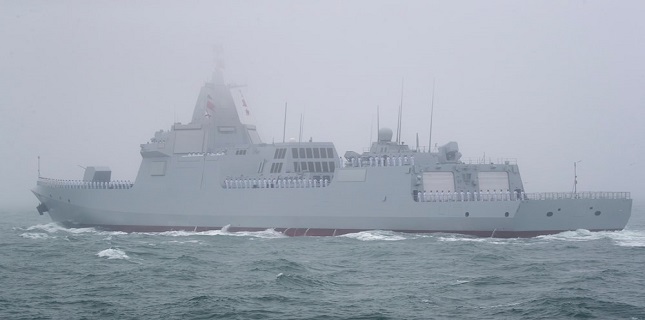
China has begun combat training exercises with its two most recently commissioned warships, signaling a new phase in the country’s rapid naval expansion and intensifying pressure on the United States to accelerate its own fleet modernization, a report by the Military Watch Magazine revealed.
The Anqing and Dongguan, the ninth and tenth ships of China’s formidable Type 055 destroyer class, were confirmed in early March to have entered service as part of a second production batch, incorporating upgrades over their predecessors.
Both ships operate under China’s Eastern Theatre Command Navy, the fleet responsible for the strategically sensitive East China Sea, where Chinese forces face US and Japanese naval power on a daily basis and for any potential operations involving Taiwan.
A warship built for dominance
The Type 055 is not a conventional destroyer in the way most people understand the term. At roughly 13,000 tons, it dwarfs most Western destroyers and is closer in size to a cruiser.
Each ship carries 112 missile launch cells, more than any comparable Western vessel, capable of firing a wide range of weapons, including cruise missiles, surface-to-air missiles, and the YJ-20 anti-ship ballistic missile, a long-range weapon specifically designed to threaten enemy aircraft carrier groups.
What truly sets the class apart, however, is its ability to control the airspace around it. Its long-range HHQ-9 surface-to-air missiles can engage targets, aircraft, drones, cruise missiles, and ballistic missiles, at distances of up to 300 kilometers, allowing a single ship to effectively police an area of airspace larger than the United Kingdom.
A newer variant, the HHQ-9C, unveiled in September 2025, extends that advantage further with improved range, accuracy, and response time.
The ship’s sensor suite is equally impressive, featuring a dual-band radar system comparable to technology the US Navy had planned, but ultimately failed, to integrate onto its own Zumwalt-class stealth destroyers.
That radar, combined with advanced data links, allows the Type 055 to guide missiles toward targets using information fed from other ships or aircraft, extending its effective reach well beyond the horizon.
Washington’s dilemma
The emergence of a ten-ship Type 055 fleet has placed the US Navy in an uncomfortable position. Its frontline destroyer, the Arleigh Burke, a design dating to the 1980s, is running out of room for meaningful upgrades, constrained by limitations in space, weight, and power generation that were never anticipated when the ship was first conceived.
The Zumwalt stealth destroyer, once envisioned as its successor, was cut from a planned fleet of 32 ships to just three following severe cost overruns and performance shortfalls.
The US response is the DDG(X), a next-generation destroyer currently in development. The Type 055 program is widely credited as a primary driver behind Washington’s urgency to fast-track it. US and Japanese Aegis-equipped ships do retain a meaningful edge in one specific area, intercepting ballistic missiles mid-flight, but across broader combat metrics, the balance has shifted.
China has spent a decade quietly building the world’s most powerful surface warships. With ten now in service and the newest two already in training, that fleet is no longer a future threat, but a present one.
Must Read