Mass protests erupt in Kashmir after Sayyed Khamenei’s martyrdom

WebDesk
03 March, 2026 07:21
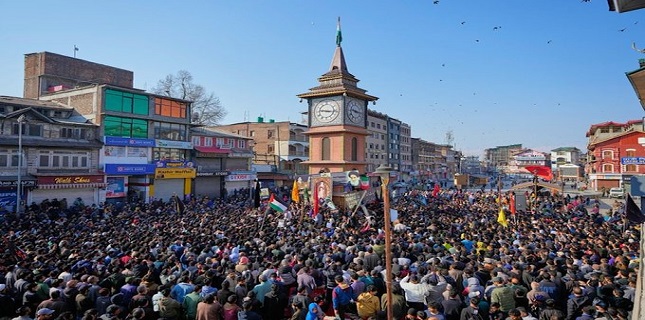
Tens of thousands of people took to the streets across Indian-occupied Kashmir to protest and mourn the killing of Iran’s Leader Sayyed Ali Khamenei.
Demonstrations were reported in Srinagar, Budgam, Baramulla, Bandipora, Pulwama, and Kargil, with protesters carrying black flags and portraits of Sayyed Khamenei while chanting anti-US and anti-“Israel” slogans.
Security measures and internet restrictions imposed
In the days leading up to the aggression, Kashmiris reported a heightened security presence across the valley. After news of the killing broke, authorities appeared braced for unrest, deploying additional forces and slowing internet services.
These protests are among the largest demonstrations involving clashes with security forces in Kashmir since August 2019, when India revoked Article 370 of the constitution, stripping the region of its limited autonomy and bringing it under tighter direct control.
Large demonstrations in Kashmir have also taken place in recent years in response to developments in the wider region. In 2024, Kashmiris staged protests following the martyrdom of Hezbollah Secretary General Sayyed Hassan Nasrallah, with crowds gathering in Srinagar and other parts of the valley to mourn. Videos circulated at the time showed protesters chanting the slogan, “Hayhat Minna Zillah,” meaning “we are far from humiliation.”
Leaders respond as mourning spreads
Kashmir is a majority Sunni region, but it is home to a large Shia population estimated at around 10–15 percent.
Support for Sayyed Khamenei in Kashmir appeared to cut across communal lines, with Mirwaiz Mohammad Umar Farooq of the Jamia Masjid condemning the killing and calling for a strike in Kashmir on Monday.
In Pakistan-controlled Kashmir, significant protests were also reported. In the city of Skardu, demonstrators reportedly set fire to a UN office, according to Press TV.
The Jammu and Kashmir government in Indian-occupied Kashmir ordered the closure of all educational institutions for the next two days.
Protesters condemn US and “Israel”
In Srinagar, protesters holding red, black, and yellow flags converged on the main square in a gathering described as emotionally charged but largely peaceful.
“This day we are all very heavy-hearted. We are mourning our beloved leader who was martyred,” Syed Towfeeq, 40, told AFP.
“We all have a message for Trump … We will always stand against your oppression. If you think that you have martyred our beloved leader, you are in an illusion … You cannot oppress while we, the sons of Khamenei, are alive.”
Similar protests were reported in other parts of Kashmir.
Political reactions in Jammu and Kashmir
Jammu and Kashmir Chief Minister Omar Abdullah said those mourning Sayyed Khamenei’s martyrdom should be allowed to do so peacefully, urging the administration to “exercise utmost restraint and refrain from using force or restrictive measures”.
J&K PDP chief Mehbooba Mufti condemned Sayyed Khamenei’s martyrdom, calling it a “shameful point in history,” and criticised the US and “Israel” while offering prayers for the people of Iran.
Khamenei’s historical connection to Kashmir
Kashmir has longstanding cultural and linguistic ties with Iran, and has at times been referred to as “Little Iran” due to the depth of Persian religious and intellectual influence in the region.
Beyond these historical links, Sayyed Ali Khamenei maintained a personal connection to Kashmir stemming from a visit in late 1980 or early 1981. In his memoir, activist Qalbi Hussain Rizvi Kashmiri described the trip as a turning point in the valley’s sectarian landscape.
According to Rizvi, one of the most consequential moments of the visit was Sayyed Khamenei’s decision to participate in Sunni Friday prayers in Srinagar. He stood alongside Mirwaiz Maulawi Farouq at a prominent Sunni mosque and delivered a brief address, an unprecedented gesture at a time when mistrust between Shia and Sunni communities ran deep, and religious boundaries were rigidly observed.
Rizvi wrote that sectarian divisions had historically been so entrenched that members of one community often avoided entering the other’s mosques. Against that backdrop, Sayyed Khamenei’s appearance carried symbolic weight that extended far beyond the sermon itself. He wrote that, in the months and years that followed, it became more common for Shias and Sunnis to pray in each other’s mosques and participate more freely in shared religious spaces.
Must Read