Supreme Court bars implementation of bill clipping CJP’s powers

13 April, 2023 17:23
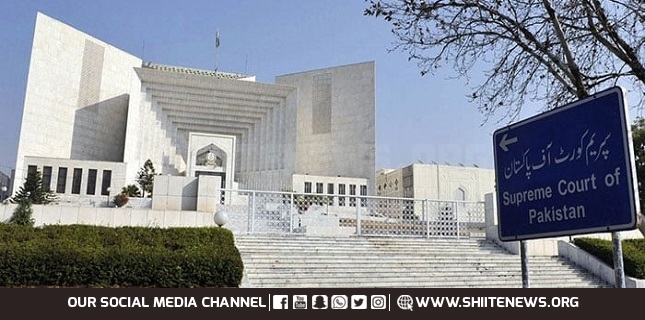
Supreme Court bars implementation of bill clipping CJP's powers
Amid a standoff between the government and the judiciary, the Supreme Court of Pakistan on Thursday ruled that the Supreme Court (Practice and Procedure) Bill will not have any effect, nor will it be implemented or enforced in any manner until further notice.
The ruling comes hours after the National Assembly unanimously passed a resolution calling for the dissolution of the eight-judge larger bench of the Supreme Court which was constituted by the Chief Justice of Pakistan (CJP) Umar Ata Bandial to hear the petitions against the bill.
An eight-judge larger bench of the apex court heard the petitions against the bill, which seeks to curtail the CJP’s powers to initiate suo motu proceedings and constitute benches on his own.
Besides the CJP himself, the larger bench comprises Justice Ijazul Ahsan, Justice Muneeb Akhtar, Justice Mazahar Ali Akbar Naqvi, Justice Muhammad Ali Mazhar, Justice Ayesha Malik, Justice Hasan Azhar Rizvi and Justice Shahid Waheed.
“In our view, the facts and circumstances presented here are extraordinary both in import and effect. Prima facie the contentions raised disclose that there is a substantial, immediate and direct interference with the independence of the judiciary in the form of multiple intrusions, in the guise of regulating the practice and procedure of this Court and conferring upon it a jurisdiction that appears not to be permissible under any constitutional provision,” the written order by the eight-member bench stated.
According to the order, any interference in the functioning of the court, even on the most tentative assessment, would start as soon as the bill becomes an act.
“Accordingly, in our view, an interim measure ought to be put in place, in the nature of an anticipatory injunction. The making of such an injunction, to prevent imminent apprehended danger that is irreparable, is an appropriate remedy, recognised in our jurisprudence and other jurisdictions that follow the same legal principles and laws.”As soon as the bill receives the assent of the president or is deemed to have received it, the order stated, the act that comes into effect shall not have any effect or be acted upon in any manner until further orders.
The bench issued notices to Attorney General for Pakistan, Supreme Court Bar Association, Pakistan Muslim League-Nawaz, Pakistan Peoples Party, Pakistan Tehreek-e-Insaf, Jamiat Ulema-e-Islam, Jamaat-e-Islami, Awami National Party, Muttahida Qaumi Movement, Balochistan Awami Party and Pakistan Muslim League-Quaid.
As the hearing commenced, AGP Mansoor Awan and the petitioner’s lawyers Advocate Azhar Siddique and Advocate Imtiaz Rashid Siddiqui were present in the courtroom.
Petitioner Raja Amir’s lawyer, Imtiaz Siddiqui, opened the arguments and stated that the case was of “great importance” due to the ongoing situation. He added that after the Qasim Suri case, the political divide across the aisles had increased significantly.
Siddiqui continued that the political crisis in the country had proliferated after the restoration of the National Assembly.
He further argued that the federal government and the Election Commission of Pakistan (ECP) were not willing to hold elections, thus the court itself had to take notice of the matter and order the ECP to conduct polls.
“On April 3, the court ordered elections, however, after the court’s directives to follow the Constitution, more problems were created. The court and judges were criticised personally, ” he said.
Siddiqui held government ministers and parliamentarians responsible for this.
The lawyer stated that the proposed legislation interfered with the independence of the judiciary.
He detailed that after approval from both houses, the bill was sent to the president who raised objections and sent the bill back to the assembly, however, the president’s objections were not reviewed. He added that the bill would become law in ten days after approval by the joint session.
“Under Article 191 of the Constitution, the Supreme Court makes its own rules,” he said.
He stated that under the bill, a three-member committee would decide on the suo motu notices and the formation of benches. He highlighted that the main question was if the bill was worthy of becoming law.
“It is illegal for the Cabinet to ratify the bill. Bill presentation and approval in the cabinet are both administrative matters,” he said, adding that presenting the bill in the NA and getting approval was “unconstitutional”.
Siddiqui maintained that the bill was not pending but was a proposed act and would become part of the law after the president’s approval.
He clarified that the SC could invalidate the bill passed by the Parliament, adding that the top court could not exist without the CJP.
“The Supreme Court completes its work with the appointment of the CJP and even if there are other judges without the Chief Justice, the court is not complete,” he said.
He argued that the powers of the CJP and judges could not be reduced, and the office of the CJP could not be used by any other judge. He questioned how the CJP’s office could be shared with two other senior judges.
Siddiqui remarked that the SC had given several decisions on the independence of the judiciary and could review the actions of every institute of the state.
“The Supreme Court declared in the Qasim Suri case that the actions of the Parliament can also be reviewed by the court,” he said.
He furthered that in the past the court declared that bills could not be stopped from passing, however, if the bill is passed the court can review it. He added that according to court decisions, the proposed act can be reviewed even before it assents to the president.
According to the lawyer, the current case was of Article 184(3) of the Constitution, wherein the SC had superior jurisdiction. He highlighted that in the past, the SC had even ordered the demolition of a marriage hall under the Article.
He maintained that all the orders of the court were subject to fundamental rights, and questioned the independence of the judiciary was not a fundamental right of the people.
He also stated that the proposed law sought to curtail the powers of the CJP, but Article 184(3) gave the right to review not appeal. Siddiqui added that an SC judge could not appeal against another judge.
“The question is whether Parliament can regulate the internal affairs of the judiciary”.
Ahead of the hearing, a large number of lawyers, including pro-PTI lawyers, were present outside the top court. PTI leader Azam Swati was also present outside the SC. Slogans were raised by the lawyers against the government and in favour of the judiciary.
The SC’s security was tightened. A large of Rangers personnel, police and frontier corps (FC) were present inside and outside the court.
The petitions
Three petitions have been filed in the top court against the bill so far. Two of them were filed by citizens Chaudhry Ghulam Hussain and Raja Aamir Khan through their lawyers Advocate Tariq Rahim and Azhar Siddique.
In the petitions, the federation, law ministry, principal secretary to Prime Minister Shehbaz Sharif and principal secretary to President Dr Arif Alvi have been named as respondents.
The petitions argue that the proposed bill was based on “bad faith” and was “fraudulent” with the Constitution. They request the SC to nullify the proposed bill as “unconstitutional” and “illegal”.
The court has also been asked to suspend the proposed law until a decision on the petition was made and to prevent the president from signing the bill.
Must Read