Next generation of militants may emerge from universities, colleges in Pakistan

13 July, 2017 10:07
“Radicalisation [is] growing at academic institutes with the CTD assessing that the next generation of militants [is] more likely to have university education rather than a madressah background,” said Additional IG Dr Sanaullah Abbasi who heads the CTD in Sindh.
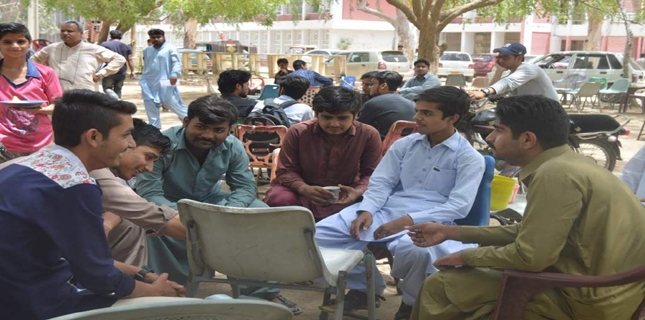
Leading academicians have called for a coordinated and strong policy to check extremism that they believe is no more limited to conventional madressahs (seminaries) but can now be found in reputed public and private educational institutions, negating that the ‘myth’ that radicalisation is linked with poverty and illiteracy.
They expressed these views at a seminar titled ‘Growing radicalisation in educational institutions’, which was organised by the Sindh police’s Counter-Terrorism Department (CTD) at the Central Police Office on Wednesday.
They sought immediate guidelines from every concerned segment of society including law enforcement and intelligence agencies to build a counter-narrative against extremism, which was fast attracting the educated youth of the province.
Vice chancellors and other officials of around 40 varsities, both private and public, attended the seminar.
The law enforcers and academics agreed to set up vigilance committees, enhancing surveillance, organising seminars at varsity auditoriums to sensitise the faculty members and students. They also promised to take up ‘practical issues’ with higher authorities.
“Radicalisation [is] growing at academic institutes with the CTD assessing that the next generation of militants [is] more likely to have university education rather than a madressah background,” said Additional IG Dr Sanaullah Abbasi who heads the CTD in Sindh.
“The recent cases of Noreen Leghari and Saad Aziz gave credence to this theory,” he added.
Dr Abbasi said the seminar was meant to start a discussion between varsity administrations and law enforcers to identify problem areas related to youth radicalisation and to see what possible solutions can be adopted.
The CTD chief said there’s a need to sensitise academic institutes about the gravity of the problem.
“Small pockets of radicalisation [are] emerging in academic institutes,” said another CTD officer Munir Ahmed Shaikh.
Citing the case of Noreen Leghari who was radicalised through ‘social media’, the CTD SSP Operations said the varsity administration later told them that they had “detected certain behavioural changes” among several girls of the medical university, as a group of 10 to 15 girls used to attend ‘dars’ in ‘isolation’.
“There [is] a thin line between preaching and radicalisation,” observed Mr Shaikh.
CTD’s SSP (Intelligence) Omar Shahid Hamid said the department had assessed that youths that had been radicalised at academic institutes were “sophisticated and trained”.
“Radicalisation is growing and we fear that the militants are more likely to emerge from secular academic institutes,” said the CTD officer.
Mr Hamid cited the case of a 31-year-old man who studied at the prestigious Karachi Grammar School (KGS), graduated from LUMS and later on started teaching at the KGS. He was radicalised to the extent that he went to Waziristan, where he got injured in a drone strike. “Now he’s working on de-radicalisation after realising the horrible consequences,” he added.
Must Read

Pakistan
Modern Hussainiya Auditorium Inaugurated in Lahore by Anjuman Hussainiya Khawajgan
29-September،2026
Pakistan
Sajid Ali Naqvi Pays Tribute to Martyr Khursheed Anwar on Death Anniversary
29-September،2026