28th death anniversary of Imam Khomeini held across Pakistan

06 June, 2017 08:49
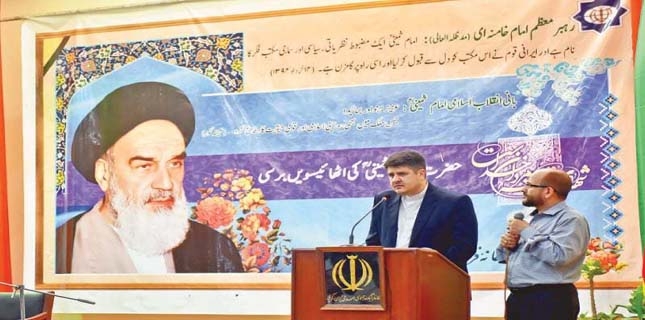
The 28th death anniversary of great revolutionary leader and founder of Islamic Revolution in Iran Grand Ayatollah Syed Roohullah Mousavi Imam Khomeini was held in all over Pakistan to pay homage to the great leader.
Ayatullah Ruhollah Imam Khomeini, the charismatic revolutionary leader who suffered incarceration, exile and even lost a young son, but never budged from the path he believed to be right. His unflinching conviction and resolute determination ultimately led him to the establishment of an Islamic government in Iran. There, too, he did not stop and relax. He carried on his mission till his last and just before that set guidelines for his nation on how to run the government successfully and with dignity. He exhorted his people not to align themselves with any of the two superpowers of the time as an inferior partner and readily pay any price needed to uphold their self-esteem.
These were some of the views of speakers — both Shia and Sunni scholars — at a gathering held at the Iranian Cultural Centre on Friday to mark the 28th death anniversary of Iran’s grand religious and political leader. They were united in showering eulogies on Imam Khomeini, who always stressed unity of Muslims beyond sectarian and theological boundaries.
Speaking on the occasion, Iranian Consul General Ahmed Mohammadi said Imam Khomeini with his conviction and sustained struggle changed the minds of the people and achieved his goal without using firearms. The diplomat said that Imam Khomeini had a multifaceted personality — as a great religious scholar, a spiritual guide and an astute politician. Every aspect of his life needed an exhaustive discussion, but he would speak on the political aspect of his personality.
He said the basis of the Imam’s politics and philosophy was purely Islamic, inspired by the Quran, Hadith and the character of the Masoomeen. He said the great leader’s struggle culminated in the establishment of a government which was essentially Islamic.
“If we sum up his achievements, it translates into the establishment of the government of Islamic Republic of Iran, where we live as Muslims with our head held high.”
The CG spoke in Persian with the help of an Urdu interpreter.
Earlier, Dr Mohammad Raza Baqri, director general of the Iranian cultural centre, also spoke in Persian. His speech, too, was summarised in Urdu by Najmuddin Musavi.
Mr Baqri said Imam Khomeini never compromised on principles and openly challenged the “anti-Islam forces” led by America. “He said the friendship of a weak nation with an imperialist power was like a friendship between a wolf and a sheep, in which there was no benefit for the latter.”
Maulana Hasan Salahuddin, a religious scholar, praised Imam Khomeini as his erudite teacher. Among other things, the speaker criticised the recently-formed Saudi-led coalition. “What have they joined hands for? To liberate Palestine and Kashmir, or just to kill their own brethren?” he remarked.
Aqeel Anjum, a provincial leader of the Jamiat Ulema-i-Pakistan, recalled that when Imam Khomeini was striving for an Islamic revolution in Iran, Maulana Maudoodi was also making such an effort in Pakistan and Hasan al Banna in Egypt. But the two leaders failed to achieve their goals because of their “flawed” approach. Video and audio clips depicting Imam Khomeini’s life, philosophy and struggle were also played at the event.
The events were also held in Islamabad, Peshawar, Quetta, and Lahore.
On the other hand, Pakistani organisations too organized the congregations from Karachi to Gilgit-Baltistan to commemorate the death anniversary.
Must Read
Pakistan
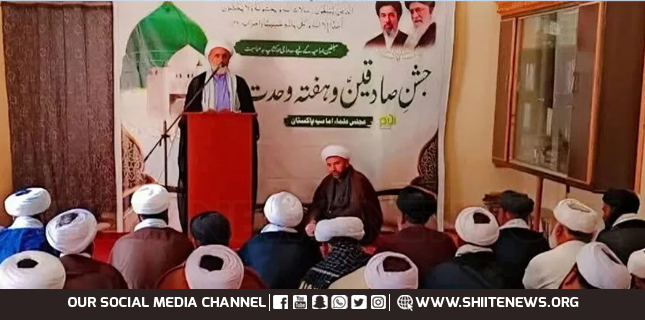
Important Educational and Training Workshop for Preachers Held by Majlis Ulama-e-Imamia Pakistan
13-September،2026

World
BRICS Summit Rejects Forced Displacement from Gaza, Demands Israeli Withdrawal from Lebanon
13-September،2026